
Almost every AI visibility tool is built for one brand. An agency needs something different: several client brands on one account, per-client access so a client sees only their own data, and enough engine coverage that a report is not full of gaps. The tools below are compared on exactly that, and the biggest difference between them is not price. It is how many AI engines each plan actually lets you track.
The short version
Every price and limit here was checked on the vendor’s own pricing page on 31 August 2026. Anything a vendor does not publish is marked as such rather than guessed.
| Tool | Engines on the entry plan | Multi-client | Entry price | Trial |
|---|---|---|---|---|
| GenAuthority | All 5 | Yes, 10 to 40 clients | $79/mo | Start free trial |
| Profound | ChatGPT only | Agency plan, separate | $99/mo billed yearly | Demo |
| Peec | Choose 3 models | 1 project on entry | Not published | Free trial |
| Otterly | 4 engines | Workspaces | $29/mo | Free trial |
| Scrunch | Not tier-limited | 1 brand workspace on Core | $250/mo | Free trial |
| PromptWatch | Track 4 models | 1 project on entry | $95/mo | 7 days |
| Semrush AI Toolkit | Add-on to Semrush | Via Semrush projects | Add-on pricing | Semrush trial |
| Ahrefs Brand Radar | Included in Ahrefs | Via Ahrefs projects | Ahrefs plan | Ahrefs trial |
Tool names link to the pricing page each figure was read from. Competitor links are nofollow.
Which AI visibility tools track all five engines?
This is the question that separates the field, and the answer surprised us when we checked.
Four of the six tools we checked do not give you every engine on every plan. They give you a choice of engines, and the number you may choose is a tier limit. Checked on 31 August 2026, on each vendor’s public pricing page:
- Profound lists its Starter plan as “ChatGPT tracking only”. Its Growth plan says “3 Answer Engines tracked”. Its full engine list is longer, including Grok, DeepSeek, Anthropic Claude and Google AI Overviews, but you are picking a subset unless you are on Enterprise.
- Peec says “Choose 3 models” on both its Starter and Pro tiers.
- PromptWatch says “Track 4 models” on its entry tiers, from a list of eight that includes OpenAI, Perplexity, Google, Claude, Gemini, Meta, DeepSeek and Grok.
- Otterly advertises “Tracking of 4 AI Search Engines” on both Lite and Standard, naming ChatGPT, Google AI Overviews and Perplexity among them.
- Scrunch lists Gemini, Meta AI, Google AI Mode, Google AI Overviews, Copilot and Grok without a per-tier engine cap on its pricing page.
Why this matters more for an agency than for a single brand: a brand tracking itself can reasonably pick the two or three engines its customers use. An agency cannot. You have a client in B2B software whose buyers live in ChatGPT, and a client in home services whose customers get answers from Google AI Overviews, and you are paying per seat or per plan either way. Every engine you cannot track is a client question you cannot answer.
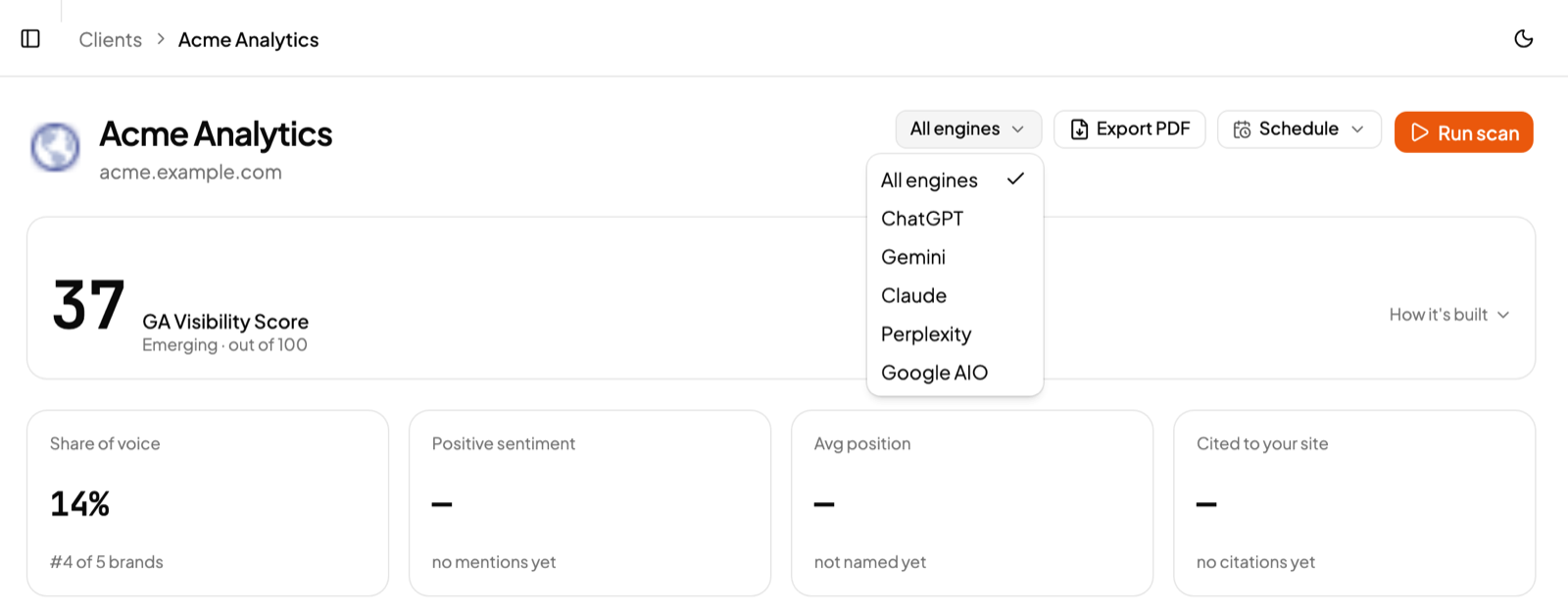
GenAuthority includes all five on every plan. ChatGPT, Google Gemini, Anthropic Claude, Perplexity and Google AI Overviews, with no add-ons and no picking three. That is the single clearest difference between us and most of this list.
It is also worth saying what we do not cover, because the same honesty applies both ways. We do not track Grok, DeepSeek, Meta AI, Microsoft Copilot or Google AI Mode. Profound and PromptWatch do. If your clients need those, they are genuinely a better fit and you should use them.
Which tools handle several client brands on one account?
An agency does not want ten logins and ten invoices. What you want is one account, a client list, and the ability to move work between them.
The pattern across this category is that entry plans are single-brand and multi-brand is a step up:
- Scrunch Core includes “1 brand workspace” and 5 user licences at $250/mo. Multi-brand is on the enterprise conversation.
- Peec Starter includes “1 project”, Pro includes “2 projects”.
- PromptWatch entry includes “1 Project”, the next tier “2 Projects”, the one above “5 Projects”. Their agency plans advertise unlimited projects.
- Profound runs a separate agency solution rather than folding it into the brand tiers.
- Otterly uses workspaces with consolidated billing across them.
GenAuthority puts client count in the plan itself: 1 on Brand, 10 on Studio, 40 on Agency. Prompts are pooled across the whole workspace rather than fixed per client, so you can put 300 prompts on one client this month and spread them across ten next month without changing plan.
Can clients see their own dashboard?
This is the feature agencies ask about first and that pricing pages describe least.
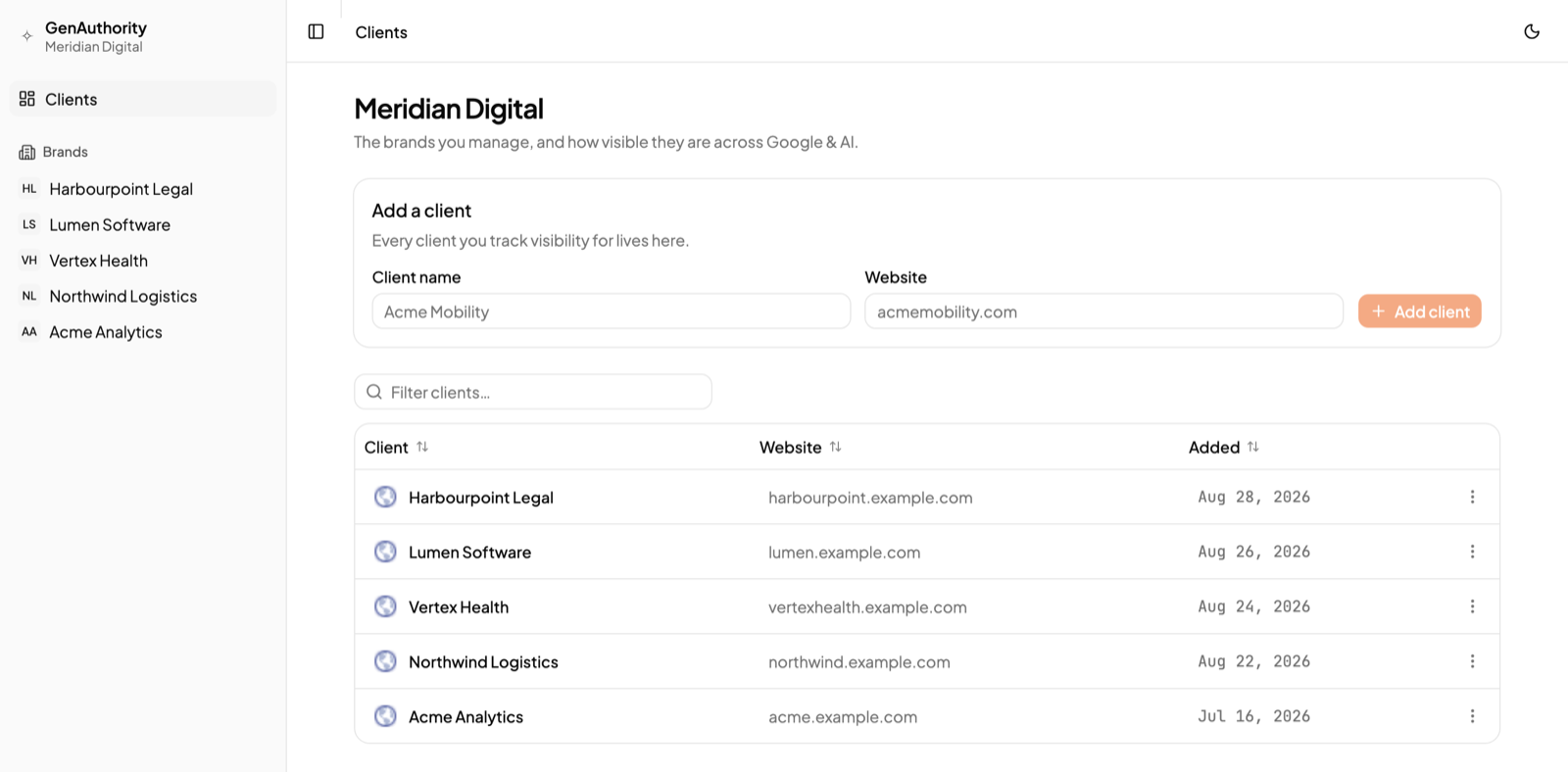
There is a real difference between “you can export a PDF for your client” and “your client has a login that shows their brand and nothing else”. The second one is what stops the weekly “can you send me an update” email.
In GenAuthority this is a role. A client user is assigned to specific brands, sees only those, and can only read. They cannot run a scan, add a prompt, change a competitor, or see that your other clients exist. It is enforced at the API, not hidden in the interface, so a client account calling the API directly is refused just the same.
Every tool on this list offers some form of client-facing reporting. What varies, and what pricing pages rarely make clear, is whether that is a true read-only role or a shared login with fewer buttons. If you are evaluating, ask the vendor directly: can a client log in, and can that login start a scan? The answer tells you which of the two you are buying.
What does AI visibility tracking cost an agency?
Entry prices in this category, verified 31 August 2026:
- Otterly Lite at $29/mo for 15 prompts, Standard at $189/mo for 100 prompts
- GenAuthority Brand at $79/mo, Studio at $149/mo, Agency at $449/mo
- PromptWatch from $95/mo for 50 prompts, $245/mo for 150 prompts
- Profound Starter at $99/mo billed yearly for 50 prompts, Growth at $399/mo for 100 prompts
- Scrunch Core at $250/mo for 125 prompts
- Peec does not publish prices on its pricing page; tiers are Starter at 50 prompts and Pro at 150 prompts
Comparing headline prices across these is misleading, because a prompt is not the same unit everywhere. A prompt tracked across three engines produces three answers; the same prompt across five produces five. Two tools quoting “100 prompts” can differ by 60% in how much they actually measure.
The number worth comparing is answers per month, which some vendors publish as “responses”. Profound lists 1,500 responses on Starter and 9,000 on Growth. PromptWatch lists 6,000 and 18,000 on its first two tiers. GenAuthority’s plans work out at 2,600, 7,000 and 24,000 answers a month.
When you evaluate, do this conversion before you compare anything. Prompts times engines equals answers, and answers is the thing you are buying.
How is this different from rank tracking?
An agency already pays for rank tracking. The reasonable question is whether this is a second bill for the same thing.
It is not, and the reason is structural. A rank tracker asks “where does this URL sit for this keyword”. An AI visibility tool asks “when someone asks this question, does the answer mention this brand, and which sources did it use to decide”. There is no position 1 to 10 in an AI answer. There is a paragraph that names three companies, and either your client is one of them or they are not.
The practical consequence for an agency: the deliverable is different. A rank report shows movement. An AI visibility report shows which sources the engines trust in your client’s category, and which of those have never mentioned your client. That second list is a work order, not a chart.
More on how the measurement itself works in what we measure and the visibility score.
What should an agency actually look for?
Five questions, in the order they matter:
- How many engines on the plan I can afford? Not how many the vendor supports. How many the tier includes.
- How many client brands, and are prompts pooled or fixed per client? Pooled is far more useful when client work is uneven.
- Is client access a real read-only role? Ask whether a client login can start a scan.
- What does it do when an engine fails? A tool that shows a confident percentage when three of five engines returned nothing is reporting on the survivors, not on your client. Ask what happens to the number.
- Seats. Per-seat pricing pushes agencies to share one login, which destroys the audit trail. Several tools here include unlimited users; check before you assume.
GenAuthority
Our own tool, so treat this section accordingly and check the rest against the vendors directly.
All five engines on every plan: ChatGPT, Gemini, Claude, Perplexity and Google AI Overviews, with no add-ons. Client brands are in the plan itself at 1, 10 and 40, and prompts are pooled across the workspace rather than fixed per client. Seats are unlimited on every tier. The client role is read-only at the API. From $79/mo, with a 14-day trial that does not ask for a card.
Where it is weakest: five engines is fewer than Profound or PromptWatch offer in total, there is no product-level tracking for ecommerce, and there is no content generation. If any of those three is a requirement, we are the wrong choice and one of the tools below is the right one.
Profound
The broadest platform on this list. Beyond visibility tracking it runs content agents, agent analytics for AI-sourced traffic, and prompt volume data. Its engine list is the longest here, covering Grok, DeepSeek, Anthropic Claude, Google AI Overviews and more.
The catch is tiering. Starter at $99/mo billed yearly is described on their pricing page as “ChatGPT tracking only” with 50 prompts and 1,500 responses a month. Growth at $399/mo covers “3 Answer Engines tracked” with 100 prompts and 9,000 responses. The full engine list is an Enterprise conversation. Agencies are served by a separate solution rather than by the brand tiers.
Choose Profound if you need engines outside our five, or you want content generation and traffic analytics in the same platform, and the budget is there for it.
Peec
A focused, well-built AI search analytics product aimed at SEO and content teams. Daily tracking on every tier and unlimited users, which is unusual and good.
Engine access is a tier limit: both Starter and Pro say “Choose 3 models”. Projects are capped at 1 on Starter and 2 on Pro, which is the constraint that matters for an agency roster. They do not publish prices on the pricing page, so you will need to talk to them or start a trial to find out. They also run a ChatGPT Shopping tracker with a Shopify connector, which we have no equivalent for.
Choose Peec if you have ecommerce clients, or you want daily tracking at a lower project count and three engines is genuinely enough.
Otterly
The cheapest entry into the category. Lite is $29/mo for 15 prompts, Standard is $189/mo for 100 prompts, and extra prompts can be added in blocks of 100 for $99. Workspaces let an agency keep clients apart with one consolidated invoice.
Both published tiers advertise “Tracking of 4 AI Search Engines”, naming ChatGPT, Google AI Overviews and Perplexity among them. Their site also runs a set of free tools and a public ranking directory, which is a sensible content play.
Choose Otterly if you are testing whether this category is worth anything to your agency at all and want the smallest possible commitment.
Scrunch
Positioned more broadly than pure measurement. Alongside visibility it does site auditing, content delivery and what it calls agent experience, which is about making a site legible to AI crawlers rather than only measuring the result.
Core is $250/mo and includes 125 unique prompts, 5 site audits a month, 1 brand workspace and 5 user licences. The engine list on their pricing page covers Gemini, Meta AI, Google AI Mode, Google AI Overviews, Copilot and Grok without an obvious per-tier cap. Multi-brand is an enterprise conversation.
Choose Scrunch if the crawlability and content-delivery side matters to you as much as the reporting, and you are working with a small number of larger clients rather than a wide roster.
PromptWatch
The most feature-dense product on this list. Eight models available (OpenAI, Perplexity, Google, Claude, Gemini, Meta, DeepSeek, Grok), crawler log analysis, visitor analytics for AI referral traffic, content agents, a knowledge base and an actions board.
Entry tiers say “Track 4 models” from that list of eight, with 1 project and 50 prompts at $95/mo, or 2 projects and 150 prompts at $245/mo. Their separate agency plans advertise unlimited projects and unlimited prompts, metered instead on responses, with 10 team seats.
Choose PromptWatch if you want the widest model coverage and crawler-level data, and metering on responses alone suits how you work better than caps on clients and prompts.
Semrush AI Visibility Toolkit and Ahrefs Brand Radar
Both of the large SEO suites now ship an AI visibility feature. If your agency already pays for Semrush or Ahrefs, look at these first, because the marginal cost is low and the data sits beside the rank tracking your reports already use.
We have not run either at agency scale and are not going to characterise their depth from their marketing pages. What we can say is the structural trade: you get convenience and one fewer invoice, and you get whatever engine coverage and refresh rate the suite has decided to include, which is not something you can tune independently.
Look at these first if you already pay for the parent suite. Compare on engine coverage and refresh frequency before assuming the bundled option is enough.
Others worth knowing about
AthenaHQ, Writesonic, AirOps, Searchable and Rankability all operate in or next to this category. We have not evaluated them properly and are not going to rank tools we have not used. Several of them are reviewed in depth by competitors on this list, which is worth reading with the obvious bias in mind.
Frequently asked questions
What is an AI visibility tool?
Software that asks AI engines the questions your customers ask, records the answers, and reports how often a brand is named and which sources the answer cited. It measures presence inside generated answers rather than position in a list of links.
How many AI engines should an agency track?
As many as the clients on your roster actually need, which is usually more than one brand would need. The important thing when comparing tools is to check how many engines the specific tier includes, because several vendors sell a choice of three or four rather than the full set.
Do agencies need a different tool than brands?
Yes, in three specific ways: several client brands on one account, prompts that can be moved between clients as work shifts, and a read-only login you can give a client. A single-brand tool multiplied by ten clients becomes ten logins and ten invoices.
How often should AI visibility be checked?
Weekly across a full prompt library is the sensible default, with a small watchlist checked daily for the questions that matter most. Daily across everything sounds better than it is: it multiplies cost several times over for movement that is mostly noise.
Can you track AI visibility for free?
You can ask an engine a question yourself and see whether a brand appears, and for one prompt on one engine that is a reasonable spot check. It does not scale to a client roster, and it does not give you the citation data, which is where the actionable work is.
How accurate is AI visibility tracking?
Accurate for what it measures, which is what the engine answered at the moment it was asked. AI answers vary between runs, so a single scan is a sample rather than a fact. Trends across repeated scans are reliable; a single-day reading is not, and any tool that presents one as certainty is overselling.
A note on method
Every price, engine count and plan limit in this post was read from the vendor’s own public pricing page on 31 August 2026. Where a vendor does not publish something, this post says so rather than estimating. Pricing in this category changes often, so check the vendor before making a decision on a figure here.
We build one of the tools on this list, which is a conflict worth stating plainly. We have tried to handle it by naming what competitors do better than us wherever it is true, and by describing every product from its own published material rather than from our impression of it.