
Answer engine optimization (AEO) is the practice of getting a brand named and cited inside the answer an AI assistant writes, rather than ranked in a list of links below it. The work is aimed at ChatGPT, Gemini, Claude, Perplexity and Google AI Overviews. It overlaps with SEO but is measured differently: the unit is not a position, it is whether you appear in the answer at all.
The short version
| Question | Answer |
|---|---|
| What is AEO? | Getting cited inside AI-generated answers, not ranked in a list of links |
| Which engines? | ChatGPT, Gemini, Claude, Perplexity, Google AI Overviews |
| How is it measured? | Share of tracked questions where the brand appears, plus which sources were cited |
| Is it separate from SEO? | No. It uses the same content, judged by a different retrieval process |
| Is it the same as GEO? | In practice yes, the two acronyms describe the same work |
What does answer engine optimization mean?
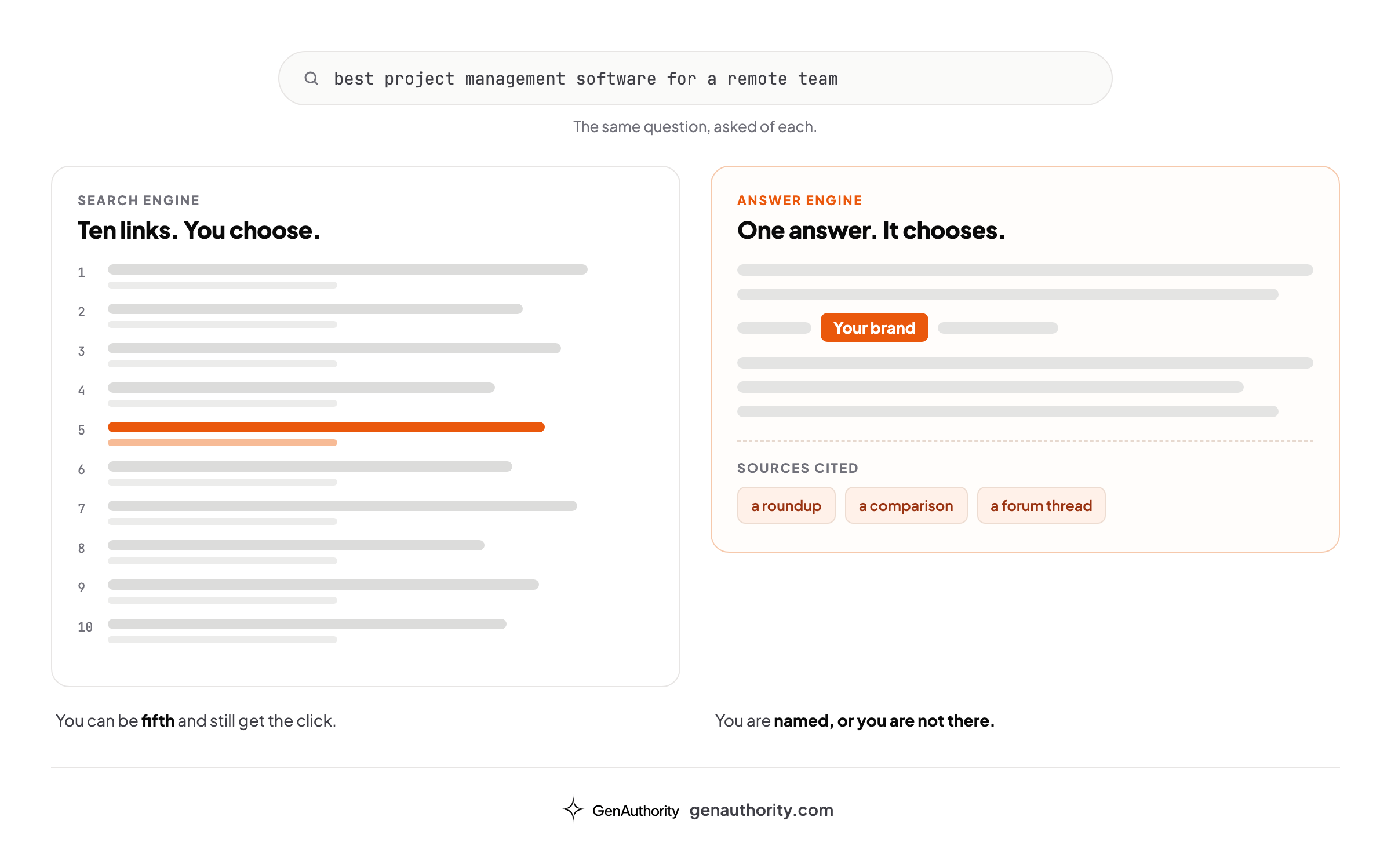
Answer engine optimization is the practice of getting a brand named, described and cited inside the answer an AI assistant produces. An answer engine does not hand back ten blue links. It reads a set of sources and writes one reply, usually naming a handful of brands and linking a handful of pages. AEO is the work of being one of those brands and one of those pages.
The name is worth taking literally. A search engine returns a list and lets the person choose. An answer engine makes the choice and explains it. That single difference is what makes the discipline distinct: on a list you can be fifth and still get the click, and in an answer you are either named or you are not there.
How is AEO different from SEO?
AEO and SEO use the same raw material, which is content on a website, and most of the technical groundwork is shared: a page that cannot be crawled cannot be cited either. Three things genuinely differ.
The unit of success. SEO measures position for a keyword. AEO measures presence in an answer. There is no position three in a paragraph of prose. A brand is named or it is absent, and the useful metric becomes the share of tracked questions where it gets named.
What gets retrieved. An engine does not search for your headline. It reformulates the question into several queries of its own, retrieves against those, and assembles an answer from what comes back. Those reformulations are called fan-out queries. A page written to match one head term is invisible to most of that retrieval.
What gets extracted. Engines pull passages, not pages. A section that only makes sense after reading the two above it will not be quoted, because the extractor never sees the two above it. Self-contained sections are worth more than a well-argued whole.
None of this makes SEO obsolete. Almost everything an engine cites is a page that ranks, and the crawlability, speed and structure work carries straight over. AEO is a second scoreboard on the same field.
Which engines does AEO apply to?
Five surfaces matter as of September 2026, and they behave differently enough that treating them as one audience is a mistake.
- ChatGPT. The largest by usage. Answers a product question by searching the web and citing sources inline.
- Google AI Overviews. Sits above the classic results on a normal Google search, so it reaches people who never opened an assistant.
- Gemini. Google’s assistant proper, distinct from AI Overviews and often citing a different source set for the same question.
- Perplexity. Built around citation from the start. It shows its sources most prominently, which makes it the easiest place to see what is actually being read.
- Claude. Answers with web search when the question needs current information.
The practical consequence is that a brand can be well represented on one engine and absent from another for the same question. Measuring one and assuming the rest is the most common mistake in this category, and it is why engine coverage is the first thing worth checking in any tool that claims to track this.
What actually gets a brand cited in an AI answer?
Here is the finding that surprised us most when we looked at our own scan record: when an engine answers a question about a category, it mostly does not cite the brands in that category. It cites everyone else.
Across three brands we track, in three unrelated industries, 731 citations went to the forty most-cited domains for each brand. Of those, 109 pointed at the brand’s own website. That is 14.9%. The other 85.1% went to competitors, directories, trade publications and forums.
| Brand | Citations to its own domain | Citations to everyone else |
|---|---|---|
| Brand A | 15.8% | 84.2% |
| Brand B | 2.2% | 97.8% |
| Brand C | 19.2% | 80.8% |
| All three | 14.9% | 85.1% |
Brand C is a large, well-known company in its own category, the kind of brand that ranks first for its own head terms. Four out of five citations in answers about its category still went somewhere other than its website.
The lesson is not that your own site does not matter. It is that publishing on your own site is a minority share of the retrieval, and a strategy that consists only of writing more pages on your own domain is competing for about a seventh of the citations available. The other route into an answer is being described accurately on the pages an engine already trusts: the roundups, the comparisons, the directories and the trade press in your category. That is a different job from publishing, and most brands are not doing it because nothing was telling them it mattered.
Method
Three brands in one workspace, in three unrelated industries. For each we took the most recent completed scan, dated between 29 July and 28 August 2026, across the AI engines we track. The tool returns the forty most-cited domains per brand, so the totals above are the sum across those forty and not every citation ever recorded. Brands are unnamed and no domains are published. This is a small sample from a single workspace, and it is reported as a pattern worth checking rather than an industry benchmark.
How do you measure answer engine optimization?
Measuring AEO means asking the engines the questions your buyers ask, repeatedly, and recording what comes back. Four numbers do most of the work.
Visibility. The share of your tracked questions where the brand appears in the answer. This is the headline number and the one that moves.
Share of voice. Your appearances as a proportion of all brands named across the same questions. Visibility can hold steady while share of voice falls, which is what a competitor gaining ground looks like before it shows up anywhere else.
Citations. Which pages the engine actually read. This is the most actionable of the four, because a page cited repeatedly in your category is a page worth being mentioned on. Our citation gap documentation covers how to read it.
Sentiment and position. How favourably the brand is described, and where in the answer it appears. Both are secondary to presence, and neither is meaningful until you appear often enough to have something to measure.
One warning about method, because it decides whether the numbers mean anything. AI answers are not deterministic. Ask the same question twice and the wording changes, and sometimes the brands do too. A single check is an anecdote. What makes it a measurement is asking the same set of questions on a schedule and watching the trend, which is also why any tool in this space should tell you when it last ran and how many answers a figure is built from. Ours is documented in what we measure.
Is AEO the same as GEO?
In practice, yes. GEO stands for generative engine optimization and AEO for answer engine optimization, and the work each describes is the same work: getting a brand cited in AI-generated answers. The two terms emerged in parallel and neither has won.
Where people try to draw a line, it is usually this: AEO is said to cover any engine that answers directly, including featured snippets and voice assistants that predate generative AI, while GEO is said to be specific to generative models. It is a real distinction historically and it makes almost no difference to what you do on a Tuesday. The tactics, the measurement and the tooling are the same.
The one place it matters is a client conversation, where using two words for one thing invites a question you do not want to spend ten minutes on. Pick one, define it once, and stay consistent.
Where to start
Three steps, in order, and the first one is not writing content.
Measure first. Pick fifteen to twenty questions a buyer would genuinely ask an assistant, with no brand names in them, and find out what the engines say today. Most brands are surprised, and the surprise is usually which competitor keeps appearing.
Read the citations before writing anything. The sources an engine returns are a list of the pages it trusts in your category. That list tells you what to write and, more often, where to get mentioned.
Then publish, in the formats that get cited. Roundups and comparisons are the formats engines reach for when a question is a choice, which describes most buying questions.
If you are choosing a tool to do the measuring, we compared the options in best AI visibility tools for agencies, including where competitors are genuinely better than us.
Frequently asked questions
Is AEO replacing SEO?
No. Almost everything an AI engine cites is a page that also ranks in classic search, so the crawlability, structure and authority work carries over unchanged. What is changing is that ranking is no longer the whole scoreboard, because a person who reads an answer may never see the list of links underneath it.
Which AI engines matter most for AEO?
ChatGPT by usage, and Google AI Overviews by reach, because AI Overviews appear on ordinary Google searches rather than requiring someone to open an assistant. Perplexity is the most useful to watch even at lower volume, because it displays its sources most openly. As of September 2026 a brand can be visible on one and absent on another for the same question, so the honest answer is to measure all of them.
How long does AEO take to show results?
We have not measured this properly and will not publish a number we cannot support. What we can say is what the mechanism implies: engines cite pages that already exist and are already indexed, so changes to a page you own can be reflected within weeks, while getting named on third-party pages moves on the timescale of that publisher, not yours.
Can you do AEO without doing SEO?
Not really. A page that cannot be crawled cannot be retrieved, and a page with no authority is rarely the one an engine chooses among several saying the same thing. The reverse is more interesting: you can do all the SEO correctly and still be absent from answers, which is exactly the gap this discipline exists to close.